Some stories are hard to hear because they reveal the truth.
Jesse’s story is one of those.
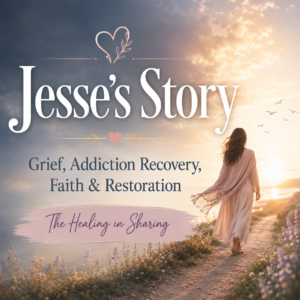
In this episode of The Healing in Sharing podcast, Jesse shares a deeply honest journey through child loss, addiction recovery, motherhood, faith, forgiveness, and restoration. Her story begins with one of the deepest losses a mother can face: the loss of her son, Eric Bradley, who died in the womb at seven months.
That kind of grief does not simply touch the heart. It can affect the body, the mind, the spirit, and how a person survives each day.
After losing Eric, Jesse also learned she had severe stage-four endometriosis. What followed was a painful season of medical trauma, repeated surgeries, heavy prescriptions, and emotional pain with nowhere safe to go. Over time, what began as help for physical pain became part of a deeper struggle.
This conversation reminds us that addiction does not always begin as people assume. Sometimes it begins with grief. Sometimes it begins with trauma. Sometimes it begins with pain treated physically while the emotional wound continues to grow.
Content note: This episode includes conversation about child loss, addiction, custody loss, drug use, spiritual struggle, and recovery.
Listen to Jesse’s full episode here:
https://www.buzzsprout.com/1771834/episodes/19250304
When Pain Becomes a Way to Survive
Jesse speaks openly about being introduced to drugs at a young age. Later, after a difficult C-section, repeated surgeries, and serious health complications, she became part of the prescription story.
At first, they were linked to physical pain. But over time, they became linked to emotional survival.
That is one of the powerful lessons from Jesse’s story. Pain does not always announce itself clearly. Sometimes grief hides behind exhaustion. Sometimes trauma hides behind functioning. Sometimes addiction becomes a way to quiet what feels too heavy to face.
Jesse shares how methamphetamine eventually became her drug of choice. She does not soften the reality of what active addiction looked like in her home. Instead, she tells the truth about it.
One of the most difficult moments in the conversation comes when Jesse describes how addiction affected her parenting. She talks about keeping a “mom’s drawer” in the house and calling what was inside “medicine.” Her son learned the rules around it, the way a child might learn the rules for something ordinary.
That part is painful to hear.
But it matters.
Because addiction can create its own logic. It teaches a person to justify, explain, hide, normalize, and survive. It can convince someone that they are managing the danger when, in reality, it is growing.
Jesse’s honesty offers us a rare look at the fear, shame, and distorted thinking that can arise during active addiction. It also reminds us that children living around addiction often learn to adapt to things they should never have had to understand.
The Moment Everything Changed
For Jesse, one of the major turning points occurred when DCF became involved.
She shares what it was like to confront the reality that her son could be taken from her. For years, Jesse believed there was one thing that would never happen: she would never lose her child.
But addiction had brought her to the point where that possibility became real.
She talks about losing custody, the shame that followed, and the unexpected grace of having a caseworker who gave her one chance to keep her son from entering the system.
That moment became a turning point.
Not because everything became easy.
Not because healing happened overnight.
But because Jesse could no longer manipulate the situation, explain it away, or keep pretending she was in control.
Sometimes the moment when everything feels like it is falling apart becomes the moment a new life begins.
For Jesse, sobriety became more than just not using drugs. It became a process of rebuilding identity, motherhood, trust, faith, and self-worth.
Learning to Look in the Mirror Again
One of the most beautiful aspects of Jesse’s recovery story is also one of the simplest.
Mirror work.
Jesse shares how hard it was to look at herself in the mirror during recovery. The idea of saying something kind to herself felt almost impossible.
So she started small.
Sixty seconds of eye contact.
At first, she could barely do it. She did not have the words, and she did not feel ready to say anything loving to herself.
One day, she looked in the mirror and said, “I love you.”
That moment opened something within her.
It was neither loud nor polished. It was not the kind of healing moment that looks perfect from the outside. It was quiet, personal, and sacred.
But it mattered.
Because sometimes healing begins with a single act of honesty. A breath. A prayer. A moment in the mirror. A willingness to look at yourself without turning away.
Jesse’s story reminds us that self-worth can be rebuilt. Not all at once. Not by pretending the past never happened. But slowly, gently, and honestly.
Recovery Is Rebuilding a Life
Jesse’s story also shows that long-term recovery requires support, structure, community, and purpose.
Through Narcotics Anonymous, Jesse connected with someone who helped her find work. That opportunity led her to biohazard and hoarding cleanup. From there, she began earning certifications, taking on greater responsibility, and building a career.
This part of her story is important because recovery is not solely emotional.
It is practical.
People need support. They need stability. They need opportunities. They need people who are willing to see who they are becoming, not only who they have been.
Jesse’s career became part of her restoration. It helped her see herself as capable, dependable, and worthy of responsibility, and gave her a new way to show up for her son and herself.
Healing can look like many things.
It can look like getting sober.
It can look like going to a meeting.
It can look like showing up to work.
It can look like becoming dependable again.
It can look like being present for your child.
It can look like learning to believe that your life still has purpose.
Faith, Forgiveness, and Restoration
Faith is woven throughout Jesse’s story.
She speaks about prayer, surrender, church, spiritual experiences, and baptism. She shares how her relationship with God became central to her healing and recovery.
Her testimony is honest about darkness, but it does not end there.
It moves toward forgiveness.
It moves toward restoration.
It moves toward being present for her child, showing up at work, loving herself, and walking in a steadier truth.
Jesse is now more than four and a half years sober. She is present in her son’s life, growing in her career, walking in faith, and learning to love the woman she sees in the mirror.
Her story does not erase what happened.
Healing does not work that way.
But her story shows that even after grief, addiction, shame, and loss, restoration is still possible.
Healing Begins in Sharing
At The Healing in Sharing, I believe there is power in honest conversation.
Not every story is easy to tell. Not every story is meant for a podcast. But when a woman is given a safe place to speak and a gentle place to be heard, something sacred can begin.
Jesse’s story is a reminder that you do not have to carry it alone.
If you are walking through grief, recovery, regret, shame, or a season of trying to find your way back to yourself, I hope this episode reminds you that healing is still possible.
You are not too far gone.
You are not beyond forgiveness.
You are not alone.
Here, survival becomes strength.
Listen to Jesse’s full episode of The Healing in Sharing podcast here:
https://www.buzzsprout.com/1771834/episodes/19250304
A Gentle Invitation
If this story touched something in you, I invite you to pause and ask yourself:
What have I been carrying that needs a safe place to be spoken about?
Sometimes you just need someone to talk to.
If you are seeking private listening support, Jen Lee Listens provides a private, supportive space to share what feels too heavy to carry alone.
You do not have to carry it alone.
Start with a conversation.