Before you begin, please know this blog discusses domestic violence, coercive control, financial abuse, human trafficking, and survivor experiences. Please read with care and pause if you need to.
If you are in immediate danger, call 911. If you are in the United States and need confidential support, contact the National Domestic Violence Hotline by calling 1 800 799 SAFE, texting START to 88788, or visiting thehotline.org.
Listen to the episode here: https://www.buzzsprout.com/1771834/episodes/19267546
Domestic violence rarely starts with a punch.
Sometimes it starts with help.
A partner offers to hold your credit cards. A partner says you do not need to carry a purse. A partner orders for you at restaurants. A partner wants the relationship to move quickly. At first, it can feel protective. It can feel romantic. It can feel like someone finally wants to take care of you.
But in Michelle Jewsbury’s story, what seemed initially like care gradually became control.
Michelle, founder of Unsilenced Voices and author of But I Love Him, joined The Healing in Sharing Podcast to discuss domestic violence, coercive control, human trafficking, survivor advocacy, and the long journey back to herself. Her story gives voice to something many survivors know deeply: abuse often begins before the visible bruises.
It can begin with your choices narrowing.
It can begin with your money being monitored.
It can begin with your community fading away.
It can begin with someone else becoming the center of every decision..
When Care Becomes Control
One of the hardest parts of abusive relationships is that the warning signs are not always obvious at the beginning.
Michelle shared that her partner wanted to hold her credit cards. He discouraged her from carrying a purse. He ordered for her when they went out. He wanted the relationship to move fast. Over time, he isolated her from friends, community, and the career path that made her feel alive.
That is how coercive control often works.
It does not always show up as rage at first. Sometimes it shows up as attention. Sometimes it sounds like protection. Sometimes it feels like love.
But love does not take away your access to money. Love does not separate you from the people who care about you. Love does not make every decision for you. Love does not leave you afraid of what might happen if you say no.
A loving relationship should help you feel more like yourself, not less.
Financial Abuse Is Still Abuse
When people think of domestic violence, they often think of physical violence first. But abuse can also be emotional, verbal, sexual, spiritual, psychological, or financial.
Financial abuse is one of the ways an abusive partner gains power.
It may look like controlling credit cards, preventing someone from working, monitoring spending, limiting access to transportation, or making one person completely dependent on the other. Michelle shared that her partner did not want her to work. He controlled when she could drive the car. He controlled money and movement.
That matters because leaving often requires resources.
A survivor may need a safe place to go, gas in the car, a phone, cash, important documents, time, and trusted support. When someone controls your money, they may also control your ability to leave.
That is why financial abuse should never be dismissed as merely a relationship issue. It is a serious form of control.
Emotional Abuse Can Change How You See Yourself
Michelle described how praise eventually turned into insults.
In the beginning, an abusive partner may make someone feel chosen, special, talented, beautiful, or needed. Over time, the same person begins to criticize, humiliate, blame, and break them down.
The survivor may keep trying to return to the version of the relationship that felt loving. She may think that if she stays quieter, explains better, behaves differently, or avoids certain triggers, things will go back to the way they were.
But abuse is not caused by the survivor failing to love correctly.
Abuse is a pattern of power and control.
Michelle shared a painful moment when she was forced to scrub baseboards on her knees after being told she had failed to manage the cleaners properly. That moment was not really about baseboards. It was about humiliation. It was about power. It was about making her feel small.
Over time, emotional abuse can lead a woman to question her memory, instincts, worth, voice, and even her reflection.
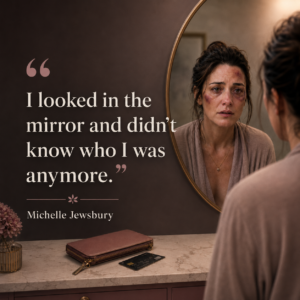
Michelle described looking in the mirror and no longer recognizing herself. That kind of loss is not a weakness. It is what happens when someone slowly wears down another person’s sense of identity.
Why Survivors Do Not Just Leave
One of the most harmful questions people ask about domestic violence is, “Why did she not just leave?”
The truth is, leaving is often dangerous, complicated, emotional, and strategic.
Michelle shared that she left multiple times before finally breaking free. Many survivors attempt to leave more than once before they can stay away safely.
There are many reasons why leaving can take time. A survivor may fear retaliation. She may lack money. She may be isolated from family and friends. She may still love the person who is hurting her. She may hope things will change. She may worry about children, pets, housing, faith, shame, or what people will think.
None of that means she is weak.
It means the abuse has created a trap that is emotional, practical, and psychological.
Michelle also shared something important for friends and family to remember. Some people left her life because they were frustrated that she had not left yet. But when a survivor is finally ready, she needs to know there is still someone safe to call.
Support does not always mean pushing harder.
Sometimes support means keeping the door open.
Leaving Requires Safety Planning
Leaving an abusive relationship is not simply a decision. It can be a safety plan.
Michelle began preparing quietly. She paid her car payments ahead of schedule when she could. She saved small amounts of cash. She created a runway for herself before she was ready to go.
For some survivors, safety planning may include gathering important documents, setting aside funds, identifying a safe place to go, establishing a code word with a trusted person, changing passwords, documenting incidents, or contacting a domestic violence advocate.
Every situation is different.
If you are in an abusive relationship, please be careful, especially if your phone, internet activity, location, bank accounts, or messages may be monitored.
If you are in immediate danger, call 911.
If you are in the United States and need confidential support, contact the National Domestic Violence Hotline.
Call 1 800 799 SAFE, which is 1 800 799 7233.
Text START to 88788.
You can also chat at thehotline.org.
If you are concerned that your internet use may be monitored, use a safer device if possible and clear your browser history after visiting domestic violence resources.
You do not have to figure this out alone.
Human Trafficking Is Not Only Somewhere Else
Michelle’s advocacy also includes raising awareness of human trafficking. In the episode, she challenges the idea that trafficking happens only overseas or only looks like what people see in movies.
Human trafficking can occur within local communities. It can involve grooming, coercion, threats, exploitation, financial dependence, and systems that make vulnerable people easier to control.
This is where domestic violence and human trafficking often overlap. Both can involve fear, isolation, manipulation, and control. Both can leave a person feeling trapped. Both can prompt outsiders to ask the wrong question.
Instead of asking, “Why did she stay?”
We need to ask, “What made leaving unsafe?”
Instead of asking, “Why did she not ask for help?”
We need to ask, “Who controlled her choices?”
Instead of assuming trafficking only happens somewhere far away, we need to recognize that exploitation can occur in homes, hotels, schools, online spaces, workplaces, and communities that appear ordinary from the outside.
That is why awareness matters.
Paying attention matters.
Reporting what you see matters.
Michelle reminds listeners that people often wait for someone else to act. But sometimes the person who needs to call, report, check in, or speak up is you.
If something feels wrong, do not ignore it.
If you hear about violence, call for help.
If you see signs of exploitation, report them.
If someone trusts you with their story, listen carefully.
You may be part of the bridge between silence and safety.
A Final Word for the Woman Who Feels Lost
If something in Michelle’s story feels familiar, please hear this gently.
You are not weak. You are not foolish. You are not responsible for someone else’s abuse. You are not too far gone.
You may feel like you do not recognize yourself right now, but the woman you were is not gone. She may be buried under fear, exhaustion, confusion, and survival, but she is still there.
Healing may begin with a single honest sentence.
This is not okay.
I need help.
I am scared.
I want to leave.
I want to find myself again.
You do not have to say everything all at once. You do not have to know the whole plan today. You do not have to prove your pain to deserve support.
You are allowed to be safe.
You are allowed to be heard.
You are allowed to begin again.
Listen to the Full Conversation
To hear Michelle Jewsbury’s full story and learn more about her journey from a domestic violence survivor to the founder of Unsilenced Voices, listen to the full episode here:
https://www.buzzsprout.com/1771834/episodes/19267546
If this conversation speaks to something you have carried quietly, I invite you to keep listening, keep reflecting, and keep taking gentle steps toward healing.
For more candid conversations about healing, survival, faith, purpose, and women finding their voices again, explore more episodes of The Healing in Sharing Podcast.
And remember, you are stronger than you think.