For many survivors of childhood trauma, memories often come back as feelings before they resurface as specific details. This episode examines how shame, survival, fragmented memory, and healing influence that experience.
That’s the question that quietly starts this conversation with returning guest Michelle and it changes everything.
Because, for many women, the details blur.
But the feeling?
That stays.
Listen to the epiosode: https://www.buzzsprout.com/1771834/episodes/19055876
When Shame Is Learned Before You Have Words
Michelle describes her childhood in an environment affected by neglect and abuse where shame wasn’t just felt but spoken over her until it became part of her being.
Those early feelings didn’t remain in childhood.
They followed her into adolescence…
into relationships that blurred the lines of consent and safety…
into a pregnancy where responsibility fell on someone who was still, in many ways, a child herself.
And yet, even there, something within her resisted.
A quiet defiance.
A decision that what hurt her… would not be passed on.
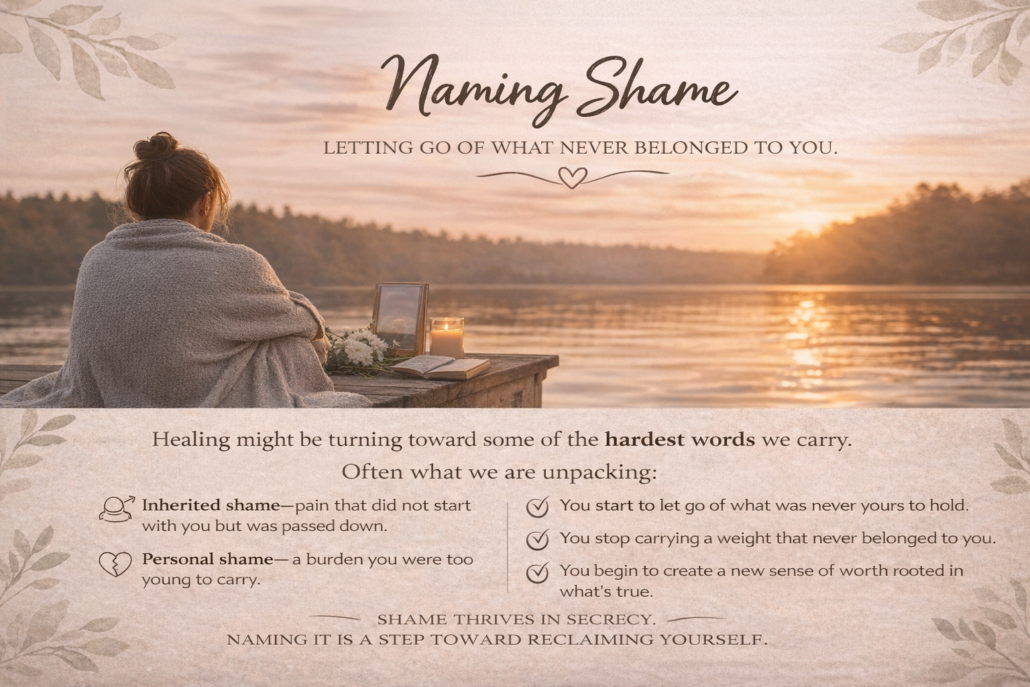
Naming Inherited and Personal Shame
One of the most impactful parts of Michelle’s story is how she starts to identify what she carried.
Not just personal shame… but also inherited shame.
Through journaling, therapy, and deeper healing work, including ketamine-assisted therapy, she began to see beyond what words alone could reach.
She describes vivid imagery: tethers, cords, and connections carrying her mother’s unprocessed pain.
And in one defining moment, she cut them.
Not to erase the past, but to stop carrying what was never hers to bear.
That’s what real healing looks like.
Not perfect.
Not instant.
But aware.
Why Trauma Memories Return in Fragments
Healing did not come in a straight line.
Some memories returned in fragments. Some came through conversations with her sister, filling in pieces she could not access on her own.
What emerged was hard to face; intrafamilial trauma, minimized harm, and a distorted understanding of what love was supposed to look like.
And like so many women, that distortion reappeared later… in relationships that felt familiar rather than alarming.
There is a moment she shares that is hard to hear but impossible to ignore.
An assault that only ended because someone else stepped in.
But what stayed with me most was not just the danger. It was the voice inside her that said: Leave.
That moment mattered.
Because that was the beginning of self-advocacy.
Choosing a Different Path in Motherhood
Motherhood transformed everything.
Michelle wanted something different for her child.
Something steady. Something safe.
But even then, the old patterns attempted to repeat themselves.
She married despite the red flags, clinging to the hope of building the family she never had.
And then came a moment that changed everything.
A doctor told her something simple… but life-changing:
Your child already feels what you feel.
That was it.
That was the line.
She chose to leave the marriage early, before chaos could become normal.
That decision?
That’s what breaking a cycle really looks like.
Grief That Changes You
Michelle’s story extends beyond survival; it also involves profound loss.
One of the most heartbreaking parts of Michelle’s journey is losing her daughter to shallow water blackout, a sudden loss of consciousness underwater caused by a lack of oxygen to the brain. It can happen when someone holds their breath while swimming, diving, or staying underwater. Such a loss does more than bring deep sadness; it can profoundly change a person.
Hear Michelle’s daughter, Maddisyn’s, journey: https://www.buzzsprout.com/1771834/episodes/16156164
How grief may change you.
It can divide life into a before and after, quietly shifting how you experience time and memory.
It can strengthen your ability to hold both love and pain at the same time.
It can challenge or reshape your faith, your beliefs, and everything you thought you understood about life.
It can sharpen your awareness of what truly matters, while everything else fades into the background.
It can live in the body showing up as heaviness, fatigue, or moments of sudden unexpected emotion.
It can leave a longing that never fully disappears, but slowly becomes something you learn to carry with grace.
It can also open your heart to a deeper compassion for yourself, and for anyone else who knows this kind of pain.
Michelle does not talk about grief as something tidy or complete. She speaks from its reality the kind of grief that can shake your identity, your beliefs, and your sense of meaning.
Healing Isn’t a Moment; It’s a Continuous Practice.
What Michelle shares is something many people need to hear:
Healing is not about fixing everything. It is about changing how you respond when old feelings come back.
Because they will.
The difference is awareness. Language. Self-compassion. Boundaries. Truth.
She stopped treating her past like an enemy and started seeing life as a teacher.
If you are reading this and something in you feels familiar…
You are not broken. You are reacting to what you have experienced.
And healing?
It does not happen all at once.
It happens in moments like telling the truth for the first time. Setting a boundary that feels uncomfortable. Choosing yourself even when it is hard. Asking for help. Letting someone truly hear you.
A Message That Stays with You
Michelle leaves us with something both simple and powerful:
You can’t go around the mountain.
You have to walk through it.
But you don’t have to walk through it alone.
Parents can choose presence over shame.
Friends can speak up when they see harm.
And women like you can start building a life that feels safe, honest, and true to themselves.
Disclaimer:
This content is shared for supportive purposes only. I am not a therapist, counselor, or medical professional, and this blog is not a substitute for therapy, mental health care, medical advice, or crisis support. If you are in danger, in crisis, or need professional help, please reach out to a licensed mental health provider or emergency services in your area.
If this story made you think of something… that matters.
You don’t have to go through it alone.

 How Do You Know If Your Teen Is in an Unsafe Relationship?